
A Conversation with Nicholas Wright
Author of Warhead

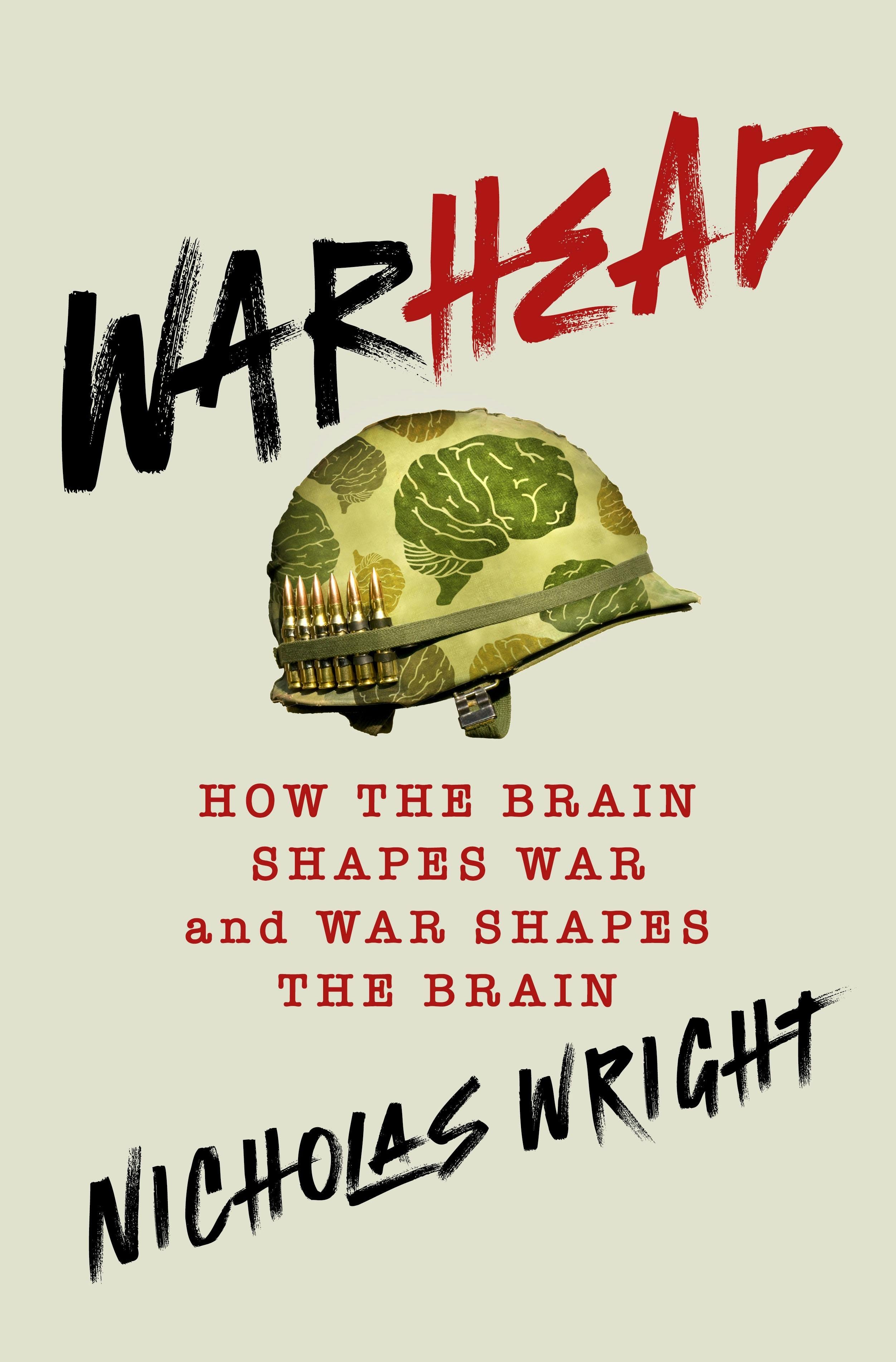
Dr. Nicholas Wright, a longtime colleague from Amy’s defense days, has written a fascinating book that examines the role of each part of the brain in that very human sphere: war. Warhead: How the brain shapes war and war shapes the brain also draws on the author’s deep knowledge of military history to highlight instances when neural workings changed the outcomes of pivotal battles.
Satori Neuro: A theme in your book is that our brains are always looking for surprise and change and difference, much more than they measure absolute magnitude when it comes to threats. How does that work, and are there examples where it has shaped history?
Nicholas Wright: It’s not that everything is about surprise or change, but that is a central part of how our brains work. We can’t possibly cope by passively sucking in all the information that’s out there in the world, so our brains operate using models of the world. That helps us link senses coming in to actions going out—actions we can take in order to achieve goals. That’s the case for all animals, from fruit flies and birds to chimps and humans.
These models are helpful, but we often need to update them as the world is changing. When our models make a prediction that turns out to be wrong, that’s an error. A major prediction error causes our models of the world to change, and that can come along with really powerful effects that feel like surprise or shock. The brain registers that something big and important has happened.
This has been a vital part of how militaries operate for millennia. Using the technologies of their time they try to create surprise in order to shock the enemy and cause paralysis. For example, the Battle of France in May 1940 involved the French and British armies on one side (the Allies) and the Nazi Germans on the other side. The French and British had more trained men, more tanks, more guns, more planes—materially they were superior. But during the interwar period, the Germans had worked out how to harness psychological factors like surprise, using what they called blitzkrieg (lightning war). They catastrophically defeated the Allies, and surprise was a big part of how they achieved that. Morale collapsed.
SN: Troops are often in places they’ve never been before, so this requires really precise orienteering and mapping and so on. But the brain has its own way to map out space. So how do those two systems of creating models interact?
NW: One of the most exciting findings in neuroscience of the last few decades is that we literally have maps of the physical world in our brains. It’s not a metaphor, we literally have those maps. They’re really in there. They are models of the terrain in which we are operating. John O’Keefe at University College London won the Nobel Prize in 2014 for showing—using a grid of electrodes in a rodent hippocampus—that you can read out where that rodent is in the real world just by looking at the pattern of activity.
Then we discovered even more sophisticated maps. For example, if your cat is hunting in your garden, it can find routes to hunt. If there are dogs in some gardens and not in others, it can simulate those different routes that might be too dangerous to take in real life. Our maps can even simulate areas we’ve seen but never been to in the past. With mice, you can look at the activity in their brains and see the mice thinking through where they’re going to go within those maps.
SN: In basic training, people are learning about things like firearms safety at the same time as being super sleep deprived. The argument I’ve heard for this is that they’ll be better able to retrieve that in a stressful situation later, according to the principles of state-dependent memory. But I’m not sure it goes in properly in the first place. Do you have a view on that?
NW: There are two parts of that. First of all, sleep deprivation has really profound effects on our performance, in part by affecting how well we learn and how well we make decisions. It is difficult for you to think forward, and often you will have micro-sleeps. If you are at university, for example, and you are studying for an exam, it is important to realize that staying up all night the day before the exam will impair your ability to do the exam the next day.
On the other hand, in the military, people sometimes need to be up all night. So we need to teach people how to cope with difficult things when they are sleep deprived so they know what it feels like. In training, they learn in uncomfortable and difficult physical environments so that then, when they face them in the real world, they are not surprised and shocked by that, and they’re able to function despite those things.
Again, you look at the Germans in May 1940, when German Panzer commander Heinz Guderian had his troops go for two weeks almost without sleep. I don’t think if the Germans had stopped every evening at 5pm and then had a really good night’s sleep that they would have done as well, and this is the reality we will always face: people who are very tough, very aggressive, and very good. So we need to be tough, aggressive, and good as well. That involves learning things and being able to cope with the harsh physical realities of combat.
SN: I can imagine those realities contribute to what people famously call “the fog of war”. But there’s a kind of physiological reality attached to that fog and the confusion about what’s really happening, isn’t there?
NW: The “fog of war” is an expression that comes originally from the Prussian philosopher of war, Carl von Clausewitz, and it refers to the fact that there will always be a level of uncertainty in everything that occurs. When new digital technologies were developed in the 1990s, people were saying we would be able to know everything that is going on on the battlefield. Everything will be known! There will be no fog of war! There will be no uncertainty about where the enemy is and what’s happening on the terrain, we’ll know everything. Clearly that didn’t pan out.
I could go on the Internet now and get incredibly high-resolution commercial satellite images of anywhere in the world that are frequently updated, but as long as humans are involved, there will always be a fog of war. If people are involved in perceiving whatever is detected by those sensors, our perceptual systems are still using their models. Our perceptual model of the world is controlled by our expectations about how the world works as well as new sensory information coming in that may reveal prediction errors.
Even if we have a super-duper AI or quantum sensor going through a quantum computer or something, humans will still have expectations that can be cheated or fooled, so there will be uncertainty. A capable adversary will always try to fool the brains that are receiving the sensory information.
SN: We all have an intuition that being a clever military strategist is different than being wise. Wisdom is one of those “I know it when I sense it” qualities. But you are saying in this book that there’s a definition of wisdom that comes down to brain activity and chemistry?
NW: Yes. Thinking rationally is fantastic, and we can think through enormously complex decision trees branching into the future to play chess brilliantly. But there’s a difference between that and being wise, which involves having a model of the world and ourselves in that world that we interrogate and ask, are we doing the right thing?
In the mid-to-late 19th century, there was a German general called Helmuth Von Moltke who won a series of battles against the French, but it came to the point in 1870 when the French didn’t give up, and if he had looked at the bigger picture he would have seen that if the war dragged on then the British and others would enter the fray and he would lose. He refused to look at that bigger picture. In contrast, Otto von Bismarck lifted his eyes, saw the strengths and weaknesses of the German position, and said, “We need to stop the war now and create peace with the French.”
This self-knowledge, introspection and thinking about our own thinking, called “metacognition”, happens in many places in the brain, but there is a particular region called the frontal pole that is really important for it. One of the remarkable things we can do as humans is gain self-knowledge using metacognition. In so doing we can enhance ourselves in our everyday lives, as well as gain self-knowledge as a human species while we are building ever more fearsome technologies for warfare.
This is part of what we are as humans, and we can’t hide from that. But reconciliation is every bit as human as conflict, and our remarkable self-knowledge is spiraling upwards through things like neuroscience. War has unfortunately emerged back onto the world stage, and it will be really vital for us to understand why people fight so we can reduce the chances of war, as well as to understand why humans lose and win wars—so that when we must fight, we can win.